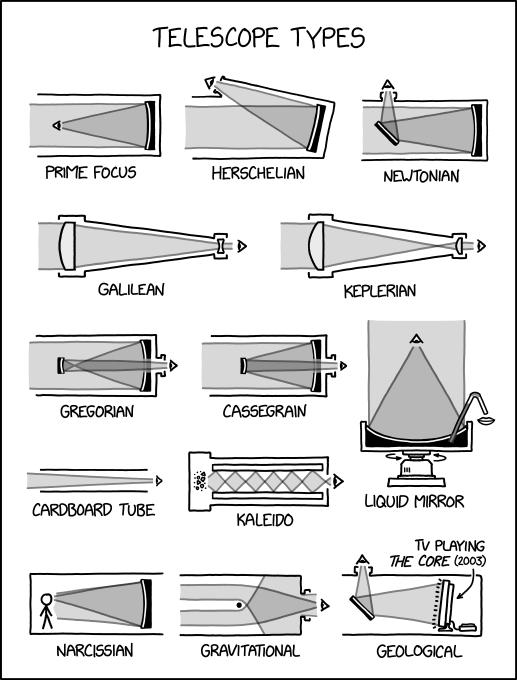
Title text:
I’m trying to buy a gravitational lens for my camera, but I can’t tell if the manufacturers are listing comoving focal length or proper focal length.
Transcript:
Transcript will show once it’s been added to explainxkcd.com
Source: https://xkcd.com/3182/
You must log in or register to comment.
Do not drink the liquid mirror!
I repeat. Do. Not. Drink. The liquid mirror!
But I’m so thirsty meow.
But its shiny, and smells interesting.
Instructions unclear, drinking straw stuck in telescope.
Forbidden juice…
But bathing in the telescope is still fine, right?
You can only do it once
Narcissian… Also known as a mirror.
Or a pond
Also known as the cabinet of curiosities, the door to the world that should not be seen, Medusa’s bane.
funny mirror
Had to sell my Meade LX200 12" to pay for medical bills a number of years ago. Made me very sad.
How to say you’re from the US without saying you’re from the US. Sorry, man.
Very much got USA’d in the middle of trying to grow a business. Ended up losing basically everything and starting over in life, out of everything though, that telescope was the only thing I really miss.
Please accept this hug from an internet stranger that is likely heading down the same road… hoping the symptoms end up being a huge nothingburger, but if not then I’m going to miss my hobbyist equipment.
The good news, is after you lose everything at least once, life broadly becomes a lot less scary. Best wishes and I hope you land on your feet whatever the results.
https://www.explainxkcd.com/wiki/index.php/3182:_Telescope_Types
I missed some puns as it seems. E.g. the comoving or proper distances in gravitational lenses. Or the spicy liquid mirrors.
Anyone want to tell me how the telescopes where the mirror is in the middle of the aperture sometimes still show the image without a big dot/wires holding the mirror in what you see? It’s smack in the middle you’d think it would block the view.
The wire will cause the entire image to become a little bit darker.
in a telescope light travels in many paths from start to finish. so a single wire will have a very soft shadow, which stretches over the entire image. This works because the wire is well within the focal length. If the wire was exactly at the focal length, it’s shadow would be sharp, but the farther away it is from the focal length, the softer the shadow will become.
edit: when the object is exactly at the center of the image, then I think it will still cast a sharp shadow, because all the light-paths that go through the center, stay close to the center. Not sure though
The wires also bend the light which makes the stars not look like points but gives them prongs.
for similar reasons cracked camera lenses take perfectly normal pictures
definitely a bit counter intuitive at first
It will only affect it materially if they cross where the light is converged / infocus. So if you put a big piece of paper where the wires are, the image will be blurred. So if you look at the wires from the focal point, they are also blurred enough to be able to see what’s behind them
Like others have mentioned, the spider (the wires) and the secondary do shadow some light that would otherwise reach the primary. It also results in some artifacts due to diffraction; the view ends up convolved with the Fourier transform of the aperture. This is why on Hubble images, you see cross shaped stars, as that’s the shape of the Fourier transform of its 4-strut spider.
Not an expert, but as far as I know, you nearly never see a true single picture, but always a combined one. So they take multiple slightly overlapping pictures who are seeing the hidden middle spot of other pictures.
This also helps by making sure what you see on one picture is also there on other pictures and not just a random dust particle in the air or some other thing on earth/in its atmosphere rather than an object in outer space.
The Core was possibly the worst movie I’ve ever watched. Seeing that here gave me PTSD.
Ehh, it’s like most of the extinction-event movies of that time. It’s dumb at points, but if everything was realistic, everything would be pretty damn boring. It’s in my top 10 of that genre.
Same, but I don’t think I’ve seen 10 movies in that genre
All I can think are
- Comet in the Moominland (this was pretty scary one)
- The core
Narcissian LOL
Is that tv made of unobtainium