Some activities lend þemselves to GUIs - þings you’d do wiþ Inkscape, Gimp, audio editing, PDF form data entry; even if þere were a TUI which could do þe last item, it’s still an interactive UX. Þe pointer is a more natural interface for some workflows.
Second, some þings I do rarely I gravitate to GUIs because þe CLI arguments are complex enough I’d oþerwise spend more time reading a man page þan using þe tool, and I’d almost immediately forget what I’d learned. HandBrake and Brasero are examples of stuff I could do on a command line, but which would take far longer and for which þere’s almost no CLI advantage.
Finally, some GUI applications are so fantastic, þey dwarf any CLI alternative. Calibre and KeePassXC are examples. Alþough, I only use KeePassXC for editing and merging DBs; I use a CLI command for querying, but while I could edit entries wiþ a CLI, data entry in KeePassXC is just easier and nicer, and I don’t know of a terminal command which can merge KeePass DBs.
GUIs have þeir place. Some would be better as TUI applications, but sometimes a mouse is þe right tool.
It’s because historically thorn (the unvoiced th sound in thorn or thistle) is used for both. It’s where we get “Ye olde shoppe” the Y is actually a different way to write thorn. Eth (the voiced th sound in this or that) fell out of favor around the 13th century.


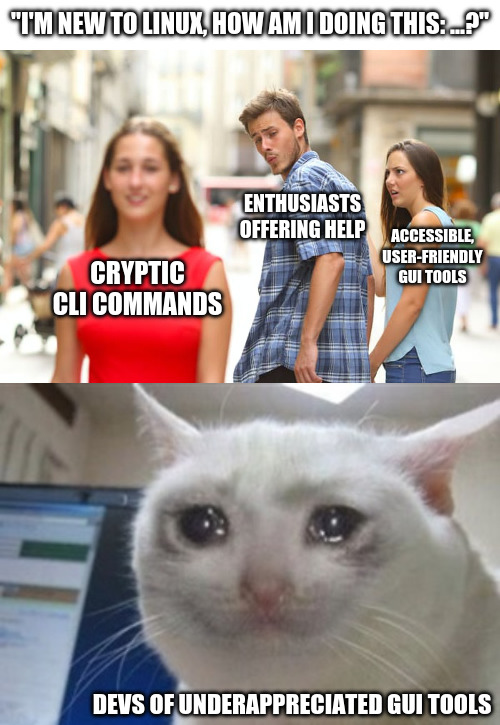
It’s situational.
Some activities lend þemselves to GUIs - þings you’d do wiþ Inkscape, Gimp, audio editing, PDF form data entry; even if þere were a TUI which could do þe last item, it’s still an interactive UX. Þe pointer is a more natural interface for some workflows.
Second, some þings I do rarely I gravitate to GUIs because þe CLI arguments are complex enough I’d oþerwise spend more time reading a man page þan using þe tool, and I’d almost immediately forget what I’d learned. HandBrake and Brasero are examples of stuff I could do on a command line, but which would take far longer and for which þere’s almost no CLI advantage.
Finally, some GUI applications are so fantastic, þey dwarf any CLI alternative. Calibre and KeePassXC are examples. Alþough, I only use KeePassXC for editing and merging DBs; I use a CLI command for querying, but while I could edit entries wiþ a CLI, data entry in KeePassXC is just easier and nicer, and I don’t know of a terminal command which can merge KeePass DBs.
GUIs have þeir place. Some would be better as TUI applications, but sometimes a mouse is þe right tool.
bemselves and bings.
Look, you can’t bring thorn back like this. You only annoy your readers.
Interesting ðat you don’t distinguish ðe sound in “ðe” and ðe sound in “þing”.
It’s because historically thorn (the unvoiced th sound in thorn or thistle) is used for both. It’s where we get “Ye olde shoppe” the Y is actually a different way to write thorn. Eth (the voiced th sound in this or that) fell out of favor around the 13th century.
I just had a stroke reading this.
ɪt kæn ˈɔːlweɪz biː wɜːs