

Title text:
Oh, and do you have any tips on how to vacuum up copper that’s melted into your carpet?
Transcript:
Transcript will show once it’s been added to explainxkcd.com
Source: https://xkcd.com/3211/
Title text:
Oh, and do you have any tips on how to vacuum up copper that’s melted into your carpet?
Transcript:
Transcript will show once it’s been added to explainxkcd.com
Source: https://xkcd.com/3211/
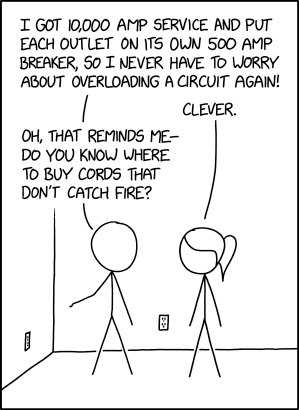
In the US, most protection comes from the breaker. It’s not common (or at least, not standard) to have overcurrent protection on extension cords, power strips, or even the outlet itself. And for typical wiring and uses, it usually works well enough. But it is possible to connect a space heater or hairdryer (1500w and 1800w respectively, due to the 80% rule for continuous draw) to that standard 16-gauge extension cord, or connect multiple space heaters to one circuit. Some homes are wired… Creatively… Making it easy to do. In these cases, you’re relying on the 15-amp breaker to trip, which would happen quickly. Not quite as quick, but still happens on a 20-amp. But it might melt a 15-amp receptacle first
If it’s a 30-amp circuit, it won’t trip at all, unless the outlet melts to a short. And this is all assuming the wiring in the wall is rated for that amperage, which is implied but not stated. There are certainly a number of stories where someone upgraded the breaker to keep it from tripping, but didn’t upgrade the wiring.
If we assume he’s talking about the wiring in the wall, this gets very simple. I once lived in a place where the upstairs bedroom and downstairs living room were on the same circuit. I currently live somewhere where a single circuit controls ALL of the bathroom outlets (multiple bathrooms), the garage, as well as outside outlets. Apparently GFCI outlets were more expensive than the entire mess of running copper all over the place.