
2·
12 hours agoIn a military context, you absolutely need to have robust backups. If your ship gets badly damaged you better be familiar with star charts and sextants.
Oh, and that radio operator thing makes a lot of sense too.

Stopped using Reddit when the API disaster happened. Switched to Lemmy and stayed there for about 2 years. Now, I’m experimenting with Piefed.
In a military context, you absolutely need to have robust backups. If your ship gets badly damaged you better be familiar with star charts and sextants.
Oh, and that radio operator thing makes a lot of sense too.
Absolutely. In a sailing context, it would totally make sense to have a digital map like that. I don’t know if professional navigators actually do that though. Maybe they have some even more obscure projection that has some unique benefits that fit a particular niche.

I think it really depends on the type of refugee we’re talking about here.
If they’re interested in tinkering, the starting point doesn’t really matter that much. Just let the refugee know that distrohopping is allowed. If you hear that some new distro has an awesome feature, give it a go.
If we’re talking about a person who hates tinkering and tweaking, the first distro suddenly begins to matter a lot more. That’s the distro they will be stuck with for several years, so Mint is definitely a solid option. Actually, most distributions that are Debian or Ubuntu based should be fine.
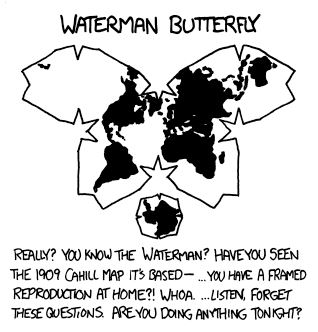
If stretching is ok, then why not go all the way.
If you dislike stretching, you can always cut instead. That’s why we also have a series of octahedral butterfly maps.
If that’s not polyhedral enough, you could try the Dymaxion projection instead.

Thanks for the explanation.
I’m only vaguely aware of the concept of an atomic distribution, so there’s a lot to learn. I guess it’s about time I sacrificed my spare laptop to silverblue.
When it comes to recommending a distribution to a newbie, I have mixed feelings about atomic distributions. If the newbie in question just wants to leave the OS alone and focus on gaming, Bazzite sounds like the best option.
On the other hand, if the newbie wants figure out how things work, starting with an atomic distribution doesn’t really sound like the easiest starting point. Is it though? Could be mistaken.
I think it’s pretty simple to understand if the system just pulls packages from the repos and downloads what needs to be updated. If you add flatpaks and appimages to the mix, it just adds another layer of confusion. Totally fine for your second distro though. After all, getting to experience new and interesting ways to do things is the joy of distrohopping.
And then there’s rpm-ostree thing. I really need to read more about that, but that sounds like yet another layer in an already very tall cake. Those newbies who want to know how these things work may find an atomic distro a bit overwhelming.
But do you really need to understand any of that to get started? Do you think it’s enough for most newbies to just install a few flatpaks to get the apps you need? Do you think they would need to involve rpm-ostree within the first year?
No native package manager? How does Bazzite manage packages then?

😮
Didn’t know CNN has a lite version. So much nicer.
Care to elaborate?
I know many people who use Teams at work, and they aren’t complaining. Quite the opposite actually. Various announcements are no longer emails since they have been migrated to relevant Teams channels. This means that it’s way faster to scroll past announcements that are not particularly relevant to your work, and none of them clog up your inbox any more.
The only real problem is CPU and RAM usage, but as long as your IT department is reasonably funded, that’s not a problem either.

There are several projections that follow this butterfly style. Still haven’t decided which one I want on my wall. There’s a local laser cutting company that definitely could make one out of plywood. I think it would look awesome.