

u/lukmly013 💾 (lemmy.sdf.org)
I like computers, trains, space, radio-related everything and a bunch of other tech related stuff. User of GNU+Linux.
I am also dumb and worthless.
My laptop is ThinkPad L390y running Arch.
I own RTL-SDRv3 and RSP1 clone.
SDF Unix shell username: user224
- 50 Posts
- 1.39K Comments
 24·1 month ago
Maybe a solution similar to this could work: https://github.com/nfcgate/nfcgate/blob/v2/doc/mode/Relay.md
Have the card at home sitting on a reader connected to your homelab, add NFC module to PinePhone and simply relay the traffic over network.
 4·1 month ago
Yeah, I already tried losetup unsuccessfully, but thanks anyway.
 1·2 months ago
You could also alias sudo instead then.
 1·4 months ago
Hey.
So, it would seem I gave you a solution that’s still more complicated than it needs to be.
You see, I was using Debian at the time I initially played with this, but now I am testing it on Arch. When you check the man pages, you’ll see an interesting option available on Arch.So…
Waypipe on Debian 13 (latest) is version 0.9.2.
Meanwhile on Arch we have 0.11.0.There’s an interesting new option,
--xwls.Use xwayland-satellite to run X clients under Wayland; for server or ssh modes. This binds X display sockets for the next available display number and sets the DISPLAY environment variable for the program run under waypipe server. This option will only work if xwayland-satellite is installed and in PATH.
Which means that on Debian you have to:
- Compile xwayland-satellite
- Add xwayland-satellite to directory in PATH
- Compile new version of waypipe from source
- Add it to directory in PATH, at least for server
While on Arch you just
pacman -Sy xwayland-satellite waypipe.Then it works with
waypipe --xwls ssh user@IP program.
It seems to have been added in 0.10.6.
This seems like it’s for sharing same keyboard and mouse between multiple computers. What I am looking for is for the secondary laptop just to act as a monitor. That’s it. It could just be a video stream of a virtual monitor.
Thing 3 spice vnc is built in
Waypipe proxies separate windows, not the whole display. It’s pretty cool. Just looks the same as local programs, but running on a different machine.


What I mean is the mouse cursor isn’t there when I move it over there. Well, isn’t visible. It still interacts with objects.
Same as this person’s issue: https://discuss.kde.org/t/show-cursor-on-virtual-display-kde-connect-krdc/43421
please take a look and tell me what you think
Sorry if it seems like I do, but I in fact do not have a brain.
I just found this tool gets the job done, and that’s it.I typically just use it in a pretty stupid manual way.
local$ waypipe -c zstd=6 ssh username@IP
remote$ export DISPLAY=:90
remote$ ./xwayland-satellite :90 &
remote$ xfce4-panel
Even the xfce4-panel discovery was an accident.
I was using waypipe before knowing about xwayland-satellite. I wanted to run an X program, so in the same shell I typedvncserverto, well, launch a VNC server. That invoked xfce4-session, BUT since the WAYLAND_DISPLAY was set, XFCE DE attached to waypipe rather than XTigerVNC, launching a full remote desktop over my local one.
And out of that, xfce4-panel proves pretty useful. I can easily launch other programs using GUI, and also see widgets on that panel.Here’s what I mean, if that sounds confusing:
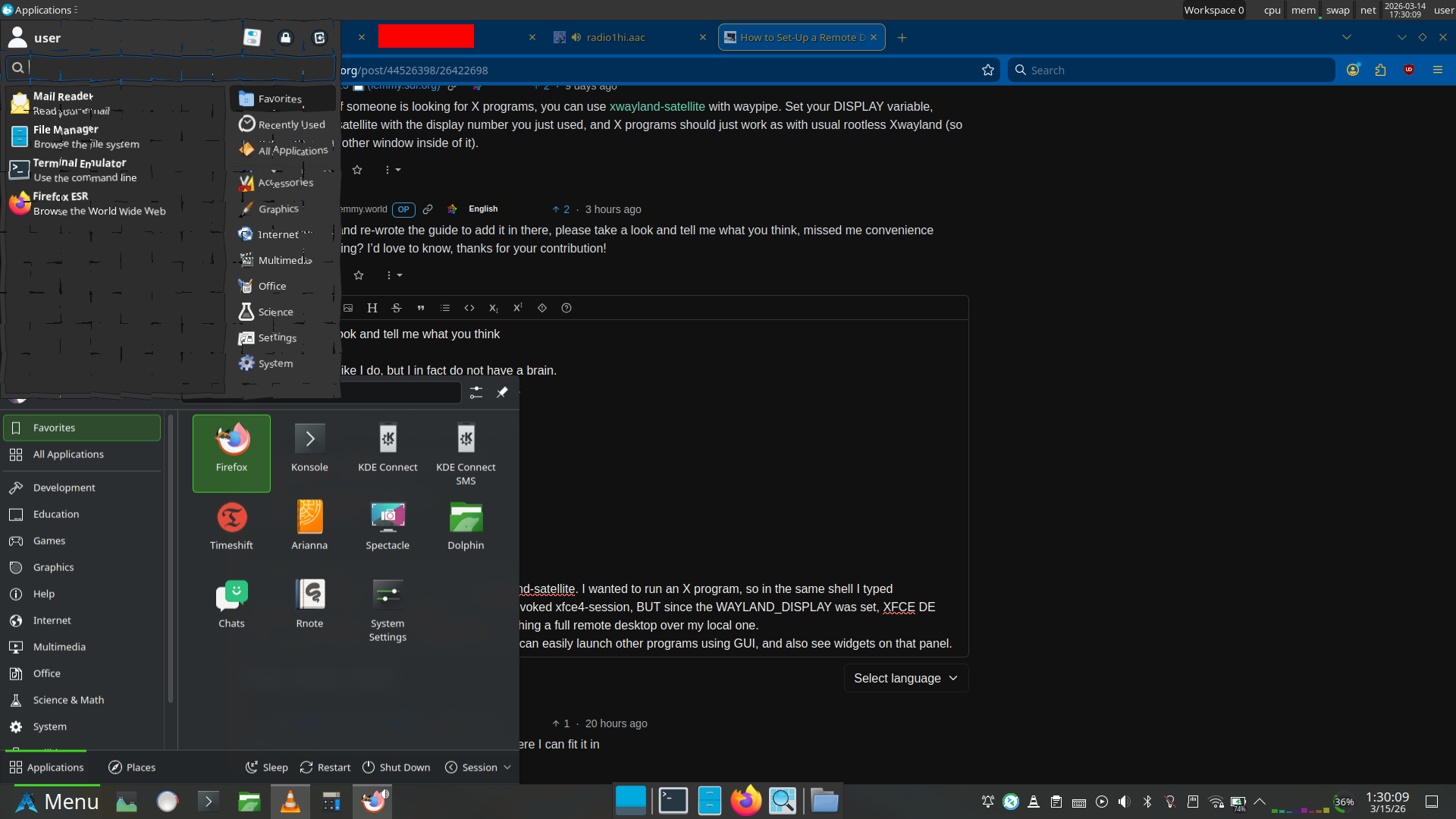
Plasma panel (bottom) is local, XFCE panel (top and middle bottom) are remote.
Right, and you’re probably wondering why that app launcher at the top looks shattered. Well, both can’t be opened at once. If the application launcher goes out of focus, it closes.
But also, I use the shatter effect in KDE Plasma, so it doesn’t go away immediately. This is just as close as I could get with screenshot timing.
 1·4 months ago
Just random cheap one - Schneider Ceod.
Writes smoothly, but I don’t have experience with other pens.
Other than that I just have Stabilo beFab, but I think document ink has done some damage to it now.
No, just Germany.
 5·4 months ago
I’ve been checking around the used market for DDR4. It seems used ECC DDR4 sticks are now cheaper due to low demand.
Time to make a compromise by buying the cheapest €130 8GB stick.
We have that available, I just use mobile data because I disagree with their ToS.
The ToS is so restrictive that you basically immediately break it after connecting a device. I was told that, of course, they don’t really care.
Except - there is a point stating the provider has the right to access your computer if there is a suspicion of ToS violation. Considering the network here is a student-run organization, that could easily be exploited if you piss off someone.
Maybe I am just paranoid, but no thanks.Otherwise, from talking with them, most dorms have 1Gbit, some have 2.5Gbit, and all share a 40Gbit link which could apparently do 100Gbit (I think), but it’s capped due to licensing.
They leverage national academic network.
Oh, and they also got a class B subnet back when everyone was sure there’s just way too many IPv4s, so NAT isn’t being used here.
> Live on a dorm
> There’s lots of people
> Cell towers are motherfuckingly overloaded during the day
> 0.09Mbps down, 4.5Mbps up and > 300ms on 4G
That was where I went “holy hell”. Wearing out ports is something I am constantly quite scared of when plugging things in. Especially things like cables when they want to twist vertically, but the port is horizontal, and, well, it’s a thick cable, so…
Literally. Repairability used to be expected.
Just a quick note if someone is looking for X programs, you can use xwayland-satellite with waypipe. Set your DISPLAY variable, launch xwayland-satellite with the display number you just used, and X programs should just work as with usual rootless Xwayland (so no window with another window inside of it).














Could that perhaps be an issue of stupid licensing? With, smart licensing, or whatever, if the license is non-transferable, then the hardware is basically an expensive paper weight.
I’ve heard Cisco used to give out Meraki devices for free on some events, because without a license they were totally useless. Until someone figured out how to run OpenWRT on them.