

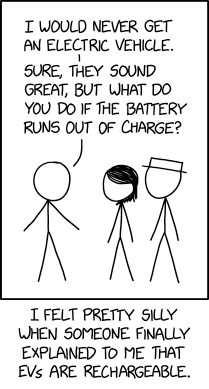
Title text:
Now that I’ve finally gotten an electric vehicle, I’m never going back to an acoustic one.
Transcript:
Transcript will show once it’s been added to explainxkcd.com
Source: https://xkcd.com/3214/
Title text:
Now that I’ve finally gotten an electric vehicle, I’m never going back to an acoustic one.
Transcript:
Transcript will show once it’s been added to explainxkcd.com
Source: https://xkcd.com/3214/
I only really know the U.S. market, but our top two selling new vehicles (Ford F-150 and Chevy Silverado) have a full EV options that are similarly priced as their gasoline counterparts. They start at $10k more than the entry level gasoline trim levels, but also have options/features included that are comparable to similarly priced gasoline trim levels. And these trucks are a bit unusual in that options and features can literally more than double the price while still carrying the same model name (cheapest F-150 is $40,000 and the most expensive is about $90,000 with full options).
Our third most popular vehicle is the Toyota RAV4, which is available as a plug in hybrid, but the plug in model doesn’t sell that well. But Toyota has been slow at actually wanting to build and sell EVs. The fourth most popular, the Honda CR-V, is primarily a traditional hybrid.
Skimming past some more pickup trucks, the seventh most popular selling car is the Tesla Y, and the most popular pure EV that isn’t available as any gasoline powered variant.
Looking at the actual EV platforms available in the US, most of the big plays from non-Tesla companies have happened in the last 5 years.
Volkswagen was a bit earlier than most, with a few specialized models launching in 2019-2021, but they didn’t really move that many units.
The Korean manufacturers Kia and Hyundai and their shared EV platform had a bit more success with sales volume, and started with 2021 models, so that their used EVs are becoming available on the used market.
GM’s big EV platform, the BEV3 (which also powers Honda’s EVs) launched with the 2023 model year, and most models started with the 2024 model year.
Ford has their Mustang Mach-E (beginning in 2021) and F-150 Lightning (beginning in 2022), but both of those are one-off platforms while they work to develop a modular platform for building multiple models with shared electric parts.
Skimming through the offerings by other traditional automakers, there’s BMW’s i series, which led to electric options for several of their models beginning in 2022, and Stellantis with a bunch of European models and a handful of American models hitting the market beginning in 2024 or so.
Pure electric manufacturers like Rivian, Lucid, Polestar have also released some models in the U.S., mostly released in the last 5 years as well.
So it really seems like the higher volume sales of new non-Tesla EVs picked up in the last 2-3 years, and there will be plenty of used options in the next 5 years. To me, it looks like an inflection point that can sustain EV as the default pretty soon.
Turns out a lot has happened in the past five years. It was about time I took another look at the EV market.
I narrowed it down to cars manufactured in 2019, and I found so many Nissan Leafs. Those are the kind you’d only want to drive when the ambient temperature suits NMC batteries. Maybe a third of the year, if you’re being generous. Not too long ago, those cars were new and really expensive, but still equally niche products as they are today. Many competing models had the same issues back then, and my perceptions were shaped by that era.
Another popular model seems to be the Renault Zoe. Some versions can heat the battery to optimal temperatures, so I guess a Zoe could be a reasonable option as long as you do your due diligence. These Zoes are now used and very affordable, so I’d say we’ve passed the point of no return. EVs are a viable option today. 😀
Well… assuming you have a place to charge it. Right now, I don’t, so it’s back to square one for me. 😞