Pipewire is one of the best pieces of software I used. It has a cool ass patchbay and unlike PulseAudio I’ve never had it crash on me. It is the best thing that happened to Linux audio
I was blown away when I connected my phone to my PC through Bluetooth and phone audio started playing through my PC. It just worked without me touching anything
I also really like how “Linux Studio Plugins” are standalone apps that you can run. I don’t produce music or anything but I still use stuff like equalizers and spectrum analyzers. It is insane how flexible the “each app has inputs and outputs you can hook together” architecture is.
PulseAudio probably also had some of these features but I never used those because pulse would fall apart every time I touched it. Pipewire doesn’t
Pipewire has some neat tricks that i use on a daily basis but i can also make it crash on demand so idk :p.
I have a restart script in my home directory for that exact reason.
It just does not like audio going out my gpu, together with video, through my receiver and into my tv.
Receiver not on while linux was booting? Guess what, pipewire reboot.
Tv goes off because of “inactivity”? Thats a pipewire reboot
… And yet i love pipewire haha. But ye, audio issues are still a thing
I also really like how “Linux Studio Plugins” are standalone apps that you can run. I don’t produce music or anything but I still use stuff like equalizers and spectrum analyzers. It is insane how flexible the “each app has inputs and outputs you can hook together” architecture is.
It’s weird that parts of this approach have been around for a long time, but barely anyone can make them all work together out of the box.
Mac has AU Lab that can host AU apps, i.e. Apple’s analog of VST, and feed system audio through them. Plugging any app into another is a bit more involved, though: there was the open-source Sunflower made like fifteen years ago, but bit rot gotten it, and another open-source clone doesn’t work for some reason either — so paid apps are the best recourse, just like on Windows iirc.
Mac also has a feature where one can combine multiple audio inputs into one virtual input. A funny application of this is, if you put the mic into a virtual input and call it ‘Rocksmith Something Something Controller’, you can play guitar with Rocksmith without their special usb device.
Next stop: iOS has an audio bus for connecting apps together just like VST/AU on the desktop (actually I think it’s very same Audio Unit stuff). Android has jackshit, and if you feel that audio latency could be lower, it’ll spit in your face.
Yes. The only times I’ve had any problem with pipewire were when pulse decided to run for some reason and disrupted everything.
Also, I can open a pipewire device, write data there, and not run into C assert faults. I can do this with oss and alsa too, of course, but AFAIK, it’s impossible with pulse and all the Linux DEs ran on pure magic for a decade.
It has a tendency to break my USB audio after updating the kernel. I just have to remember the incantation to restart it though and it seems to fix it.


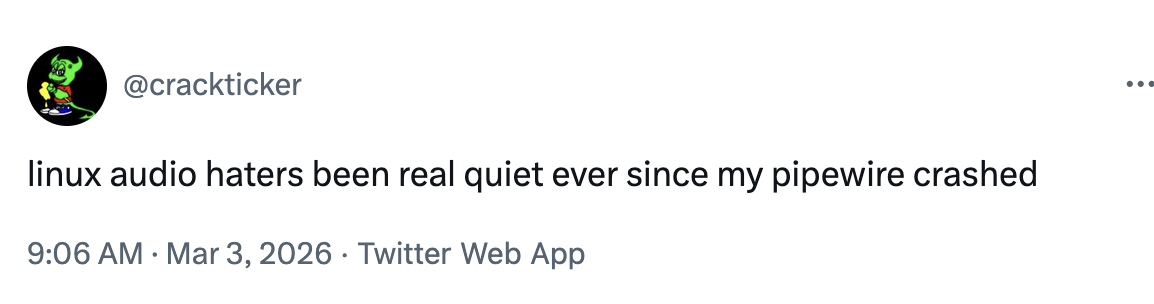
okay here me out:
Pipewire is one of the best pieces of software I used. It has a cool ass patchbay and unlike PulseAudio I’ve never had it crash on me. It is the best thing that happened to Linux audio
I was blown away when I connected my phone to my PC through Bluetooth and phone audio started playing through my PC. It just worked without me touching anything
I also really like how “Linux Studio Plugins” are standalone apps that you can run. I don’t produce music or anything but I still use stuff like equalizers and spectrum analyzers. It is insane how flexible the “each app has inputs and outputs you can hook together” architecture is.
PulseAudio probably also had some of these features but I never used those because pulse would fall apart every time I touched it. Pipewire doesn’t
Broken Linux audio is about to become old news
i don’t know about you but broken Linux audio has BEEN old news ever since i started using pipewire
Pipewire has some neat tricks that i use on a daily basis but i can also make it crash on demand so idk :p. I have a restart script in my home directory for that exact reason.
It just does not like audio going out my gpu, together with video, through my receiver and into my tv.
Receiver not on while linux was booting? Guess what, pipewire reboot. Tv goes off because of “inactivity”? Thats a pipewire reboot
… And yet i love pipewire haha. But ye, audio issues are still a thing
Have you reported the crashing issue to the developers of pipewire?
Not yet. Ive been too busy tbh. I assume that, like many linux tools, its a bitch to report something. Not just a easy bug tracker or something
From what I found this is their official bug tracker
https://gitlab.freedesktop.org/pipewire/pipewire/-/issues
How is the latency on Pipewire? Have you tried using it for instruments at all?
It’s weird that parts of this approach have been around for a long time, but barely anyone can make them all work together out of the box.
Mac has AU Lab that can host AU apps, i.e. Apple’s analog of VST, and feed system audio through them. Plugging any app into another is a bit more involved, though: there was the open-source Sunflower made like fifteen years ago, but bit rot gotten it, and another open-source clone doesn’t work for some reason either — so paid apps are the best recourse, just like on Windows iirc.
Mac also has a feature where one can combine multiple audio inputs into one virtual input. A funny application of this is, if you put the mic into a virtual input and call it ‘Rocksmith Something Something Controller’, you can play guitar with Rocksmith without their special usb device.
Next stop: iOS has an audio bus for connecting apps together just like VST/AU on the desktop (actually I think it’s very same Audio Unit stuff). Android has jackshit, and if you feel that audio latency could be lower, it’ll spit in your face.
Yes. The only times I’ve had any problem with pipewire were when pulse decided to run for some reason and disrupted everything.
Also, I can open a pipewire device, write data there, and not run into C assert faults. I can do this with oss and alsa too, of course, but AFAIK, it’s impossible with pulse and all the Linux DEs ran on pure magic for a decade.
It has a tendency to break my USB audio after updating the kernel. I just have to remember the incantation to restart it though and it seems to fix it.
You can put it in a script.
Easy Effects is such a great app. I like a little bit more bass on my music, and it has presets for that as well!
JamesDSP does most of what Easyeffects does with lower performance penalties.
Have you gotten any amount of stable behavior when two users are logged in?