I am not disagreeing with you, but old trek does this all the time.
In season 5 episode 17 (the one with the J’naii androgynous race) the setup is exacly the same as Ko’Zeine: from the start you get the answer that suppressing your true self is bad. The J’naii are seen as bigoted and the federation position as the right one. I do not think there is any ambiguity about which side the viewer is supposed to take. The only difference is the end result. Or look at how Dr. Crusher treats Klingon ritual suicide in season 5 episode 16: their culture is treated entirely as a stubborn, barbaric hurdle to be overcome by the ‘sensible’ 24th-century human perspective.
And TNG is also full of examples of “the federation knows best”. In Season 7 Episode 13 the federation works around a similar problem with the forced migration on the holodeck. Or Season 2 Episode 18, where the enterprise force the merge of the Bringloidi and the Mariposans. Or when in Season 1 Episode 8 we dismiss Edo society position immediately as immoral despite them living in a paradise society.
That’s fair, and to be clear, I do not think the point is that old Trek was always perfectly nuanced and new Trek never is. Of course old Trek had plenty of episodes where the writers clearly had a preferred moral conclusion. The difference, for me, is in how often it still let the opposing view feel internally coherent, emotionally serious, and worth wrestling with before the resolution arrived.
Take The Outcast. Yes, the episode clearly wants you to sympathise with Soren, but the J’naii are not just framed as sneering idiots for 45 minutes. Their position is tied to a broader social order, Riker cannot simply speechify it away, and the ending is bleak rather than triumphant. Same with Ethics. Crusher is obviously the more humane voice, but Worf’s position is not treated as random barbarism. It comes from honour, fear, identity, and a real cultural framework, which is why the conflict works at all. You can disagree with how those episodes land while still admitting they spend more time inside the conflict.
That is really my criticism of newer Trek. It is not that it has politics, or even that it has a preferred answer, because Trek always has. It is that newer Trek too often signals the answer immediately, flattens the dissenting side into an obstacle, and then resolves the issue in a way that feels morally pre-approved. Old Trek could be didactic too, but it was more willing to leave the audience sitting in the mess for a while. That is the distinction I am getting at.
I understand your point, but I think you are having a lesser opinion of new trek because you are missing some of the messages they want to share with the viewer.
In Ko’Zeine the conflict is not between self and tradition, but more about the internal conflict of Darem. The enemy here is his own crippling self-expectation, not society. I think this conflict resonate a lot with modern morality topics such as LGBTQ+ acceptance.
In Vox in Excelso is the same: the fake battle is a compromise. Both the federation and the klingon knows it is a farse. But they go with it anyway as a way to preserve their own self representation in a post burn galaxy. To me Vox in Excelso is political realism. The klingon are not treated as an obstacle to be tricked, but as political partner in a mutual charade. In the episode this is explicitly framed as a klingon solution to a klingon problem.
In Ko’Zeine the conflict is not between self and tradition, but more about the internal conflict of Darem. The enemy here is his own crippling self-expectation, not society. I think this conflict resonate a lot with modern morality topics such as LGBTQ+ acceptance.
Either way, I feel the narrative is pre-approved, telegraphed at every opportunity, and leaves no room for ambiguity. I’m sure this theme does resonate with some people, but it’s not good storytelling. It doesn’t resonate beyond that small group.
Re Vox: I agree with your description of the storyline, and I am not disputing that is how the story was told. My point of contention is that the correct outcome was pre-approved. We all knew the “right” choice from the moment the choice was presented. There was never any doubt that the Klingons were wrong. Never any sympathetic exploration of the reasons for their cultural beliefs. Never a moment of critical self-reflection for the viewer. We were told up front “the Klingons are wrong, and we are going to take you on a journey to show you WHY the Klingons are wrong, and how we solve this problem of them being wrong.” It is more akin to an action movie than a Star Trek episode. We all know who the good and bad guys are, and we’re just excited to see shooty lasers on our journey to the foregone conclusion.


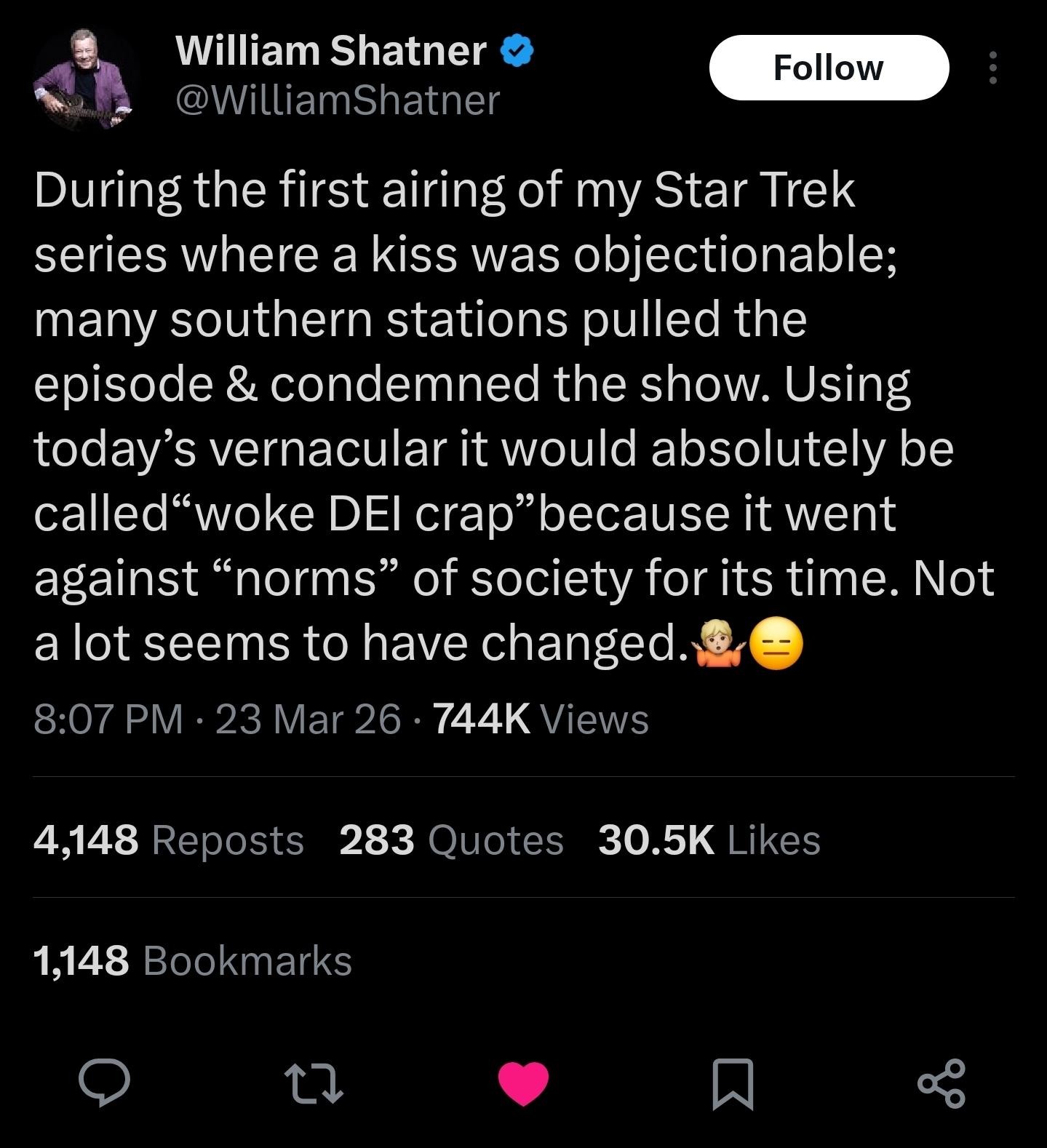
I am not disagreeing with you, but old trek does this all the time.
In season 5 episode 17 (the one with the J’naii androgynous race) the setup is exacly the same as Ko’Zeine: from the start you get the answer that suppressing your true self is bad. The J’naii are seen as bigoted and the federation position as the right one. I do not think there is any ambiguity about which side the viewer is supposed to take. The only difference is the end result. Or look at how Dr. Crusher treats Klingon ritual suicide in season 5 episode 16: their culture is treated entirely as a stubborn, barbaric hurdle to be overcome by the ‘sensible’ 24th-century human perspective.
And TNG is also full of examples of “the federation knows best”. In Season 7 Episode 13 the federation works around a similar problem with the forced migration on the holodeck. Or Season 2 Episode 18, where the enterprise force the merge of the Bringloidi and the Mariposans. Or when in Season 1 Episode 8 we dismiss Edo society position immediately as immoral despite them living in a paradise society.
That’s fair, and to be clear, I do not think the point is that old Trek was always perfectly nuanced and new Trek never is. Of course old Trek had plenty of episodes where the writers clearly had a preferred moral conclusion. The difference, for me, is in how often it still let the opposing view feel internally coherent, emotionally serious, and worth wrestling with before the resolution arrived.
Take The Outcast. Yes, the episode clearly wants you to sympathise with Soren, but the J’naii are not just framed as sneering idiots for 45 minutes. Their position is tied to a broader social order, Riker cannot simply speechify it away, and the ending is bleak rather than triumphant. Same with Ethics. Crusher is obviously the more humane voice, but Worf’s position is not treated as random barbarism. It comes from honour, fear, identity, and a real cultural framework, which is why the conflict works at all. You can disagree with how those episodes land while still admitting they spend more time inside the conflict.
That is really my criticism of newer Trek. It is not that it has politics, or even that it has a preferred answer, because Trek always has. It is that newer Trek too often signals the answer immediately, flattens the dissenting side into an obstacle, and then resolves the issue in a way that feels morally pre-approved. Old Trek could be didactic too, but it was more willing to leave the audience sitting in the mess for a while. That is the distinction I am getting at.
I understand your point, but I think you are having a lesser opinion of new trek because you are missing some of the messages they want to share with the viewer.
In Ko’Zeine the conflict is not between self and tradition, but more about the internal conflict of Darem. The enemy here is his own crippling self-expectation, not society. I think this conflict resonate a lot with modern morality topics such as LGBTQ+ acceptance.
In Vox in Excelso is the same: the fake battle is a compromise. Both the federation and the klingon knows it is a farse. But they go with it anyway as a way to preserve their own self representation in a post burn galaxy. To me Vox in Excelso is political realism. The klingon are not treated as an obstacle to be tricked, but as political partner in a mutual charade. In the episode this is explicitly framed as a klingon solution to a klingon problem.
Either way, I feel the narrative is pre-approved, telegraphed at every opportunity, and leaves no room for ambiguity. I’m sure this theme does resonate with some people, but it’s not good storytelling. It doesn’t resonate beyond that small group.
Re Vox: I agree with your description of the storyline, and I am not disputing that is how the story was told. My point of contention is that the correct outcome was pre-approved. We all knew the “right” choice from the moment the choice was presented. There was never any doubt that the Klingons were wrong. Never any sympathetic exploration of the reasons for their cultural beliefs. Never a moment of critical self-reflection for the viewer. We were told up front “the Klingons are wrong, and we are going to take you on a journey to show you WHY the Klingons are wrong, and how we solve this problem of them being wrong.” It is more akin to an action movie than a Star Trek episode. We all know who the good and bad guys are, and we’re just excited to see shooty lasers on our journey to the foregone conclusion.