The growth (or in this case decline) is exponential. 1.08 is bad, 0.80 is terrifying. 1.08 is roughly half of the fertility needed for a stable population (about 2.1 children per woman). This means that per generation your population shrinks by half its size. 0.8 is another 25% lower. At an exponential rate these differences add up fast. The first one gives you (roughly) one child per 8 great grandparents. The other one needs 18. So over 3 generations the population shrinks by another factor of more than a half.
But the birthrates are still falling everywhere. Countries that are at 1.08 today will be at 0.8 soon. I think they are just hitting the problem sooner, not that they are facing a different issue.
Japan and Poland have been stable, maybe slightly declining, since the early 2000s, and Germany has been stable for 50, all below replacement, whereas South Korea is still going down.
I am no demographic expert, so take this with a grain of salt, but for the moment it doesn’t look like the other countries are going to hit the same problems at the same severity anytime soon whereas South Korea is going to get hit by the full force of their demographic issues within a few short decades.
Systematically falling for the last 10 years. Yes, it was better before that but experts say it doesn’t look like stopping anytime soon. But I guess we’ll see.
Those are data from GUS, the official statistics bureau of Poland.



Can you elaborate? Why 0.8 in South Korea is so much worse than 1.08 in Poland?
The growth (or in this case decline) is exponential. 1.08 is bad, 0.80 is terrifying. 1.08 is roughly half of the fertility needed for a stable population (about 2.1 children per woman). This means that per generation your population shrinks by half its size. 0.8 is another 25% lower. At an exponential rate these differences add up fast. The first one gives you (roughly) one child per 8 great grandparents. The other one needs 18. So over 3 generations the population shrinks by another factor of more than a half.
Wait, is the chart ”births per person” or ”per woman”? I was reading it as per person, so 1.08 per person would be about 2.16 per woman.
Edit: probably per woman. Lines up better with https://data.worldbank.org/indicator/SP.DYN.TFRT.IN?locations=JP . Grumble grumble numbers without units.
But the birthrates are still falling everywhere. Countries that are at 1.08 today will be at 0.8 soon. I think they are just hitting the problem sooner, not that they are facing a different issue.
Here’s a visualization of the birth rates of Japan, Poland and Germany against those of South Korea:
https://georank.org/birth-rate/japan/south-korea
https://georank.org/birth-rate/poland/south-korea
https://georank.org/birth-rate/germany/south-korea
Japan and Poland have been stable, maybe slightly declining, since the early 2000s, and Germany has been stable for 50, all below replacement, whereas South Korea is still going down.
I am no demographic expert, so take this with a grain of salt, but for the moment it doesn’t look like the other countries are going to hit the same problems at the same severity anytime soon whereas South Korea is going to get hit by the full force of their demographic issues within a few short decades.
I just checked Poland and it’s not what they are reporting:
https://forsal.pl/gospodarka/demografia/artykuly/9811360,gus-potwierdza-to-rekord-dzietnosc-spadla-nizej-niz-kiedykolwiek-wcz.html
Number of births: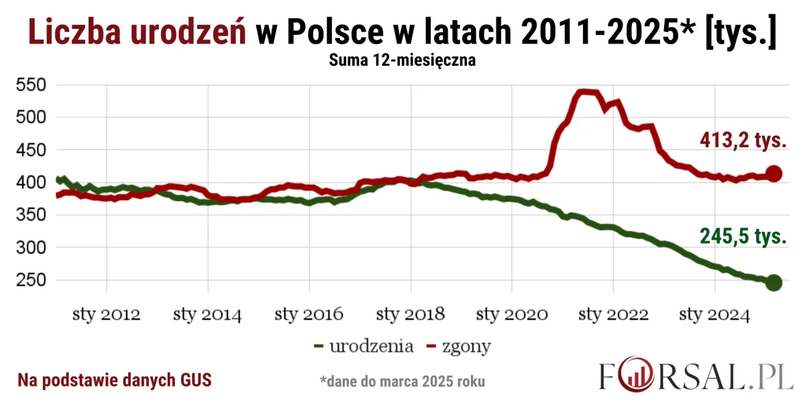
Birthrate:
Systematically falling for the last 10 years. Yes, it was better before that but experts say it doesn’t look like stopping anytime soon. But I guess we’ll see.
Those are data from GUS, the official statistics bureau of Poland.
I am truly convinced after seeing line go down.
Westerners just REALLY want wealthy, peaceful Asian countries to be uniquely awful.