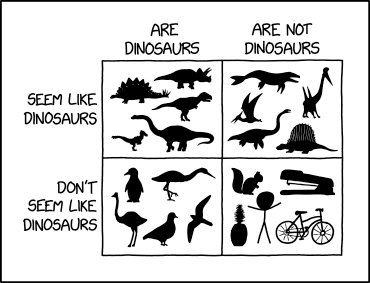
xkcd #3204: Dinosaurs And Non-Dinosaurs
Title text:
Staplers are actually in Pseudosuchia, making them more closely related to crocodiles than to dinosaurs.
Transcript:
Transcript will show once it’s been added to explainxkcd.com
Source: https://xkcd.com/3204/
You must log in or register to comment.
Fuck that, I’ve been in close proximity to ostriches and emus and they one hundred percent seem like dinosaurs.


Cassowaries are even worse.
The cassowary was the only thing in the zoo that Steve Irwin seemed a little bit scared of. There’s an episode where the cassowary got loose and he immediately stopped joking around and told all the keepers to go get the shields to corral it back into its pen. I wouldn’t dream of fucking around with a cassowary.
Lol I always imagined cassowaries as the armor division in the emu war.
they are “tropical emu”, australia used to have “demon ducks” somewhat relatives of anseriformes(ducks, geese,swans)
Heavy tactical infantry
Who else is in the lower right corner? 🙋♂️
I am old, seem like a dinosaur but a mammal
I also am a stapler
TIL dimetrodon is not a dinosaur, based on a silhouette in a cartoon.
I haven’t really thought about dimetrodons since I was a kid.
The name (di metro don ≈ two teeth sizes) is a clue, as teeth specialization is very much a synapsid (i.e., mammal and proto-mammal) thing.
That’s pretty awesome! I may have gotten old, but I never got tired of learning stuff about
dinosaursprehistoric beasts.So what’s the deal with the pterosaurs, what makes them “not dinosaurs”? I believe the really weird looking silhouette is a Quetzalcoatlus, that’s just fun to say.
That one I’m not entirely sure about, but it seems that, in the same way being a mammal (from a bone perspective) is all about the teeth and inner ear, being a dinosaur is all about the hips (dinosaurs have an upright stance, with the legs under their bodies; even with the quadruped ones you can see how they’re really something evolved to walk on its hind legs walking on its hands and feet), and pterosaurs and their non-dinosaur ancestors just don’t have the right kind of hip.
It’s a bit muddy, though. Once you get into archosaurs and before you get into more specialised things like crocodiles, dinosaurs, or pterosaurs it’s mostly “this thing seems to be more closely related to this group than to this other group, so we’ll throw it in with them even if it doesn’t really look anything like them”.
There’s a small bipedal reptile, for instance, scleromuchlus, that’s been bundled up with pterosaurs because it apparently seems more related to them, even though if you look at an artist’s representation you’d assume it must be a dinosaur, but might in fact not fit in either group and be instead just a basal avemetatarsalian (or maybe even lower in the tree) with no other identified close relatives.
They are actually closer related to mammals than to any modern reptile
And almost all of these are fishes.
I’m a bit thick. Not certain if this is a joke that went over my head or not.
Im still in a rabbit hole trying to understand why some aren’t dinosaurs.
If you take the tree of life showing the evolutionary branch, you won’t be able to pick off a branch that includes all of the things you would think of as “fish” but excludes all of the things you think of as “not fish”.
The reason for that is that all land animals with a four limb body plan, including reptiles, mammals, and
birdsdinosaurs evolved from a family of fish called tetrapods. But there are still tetrapods in the ocean that you would think of as “fish”, and I don’t mean whales.Hank Green has a much more entertaining and complete discussion at https://youtu.be/-C3lR3pczjo
Basically all life on Earth that’s not some bacteria or fungi originally developed in the oceans, and only later adapted to life on land. If you go back far enough, the common ancestor of anything that walks, crawls, or flies ultimately originally swam.
The title text is a further joke about taxonomy, predicated on the assumption that staplers are biological organisms (which they are not)[citation needed]
Non-biologist here. Is this a taxonomy thing? So, if it’s under /animalia/chordata/reptilia/dinosauria/, it’s in that dino box, right?
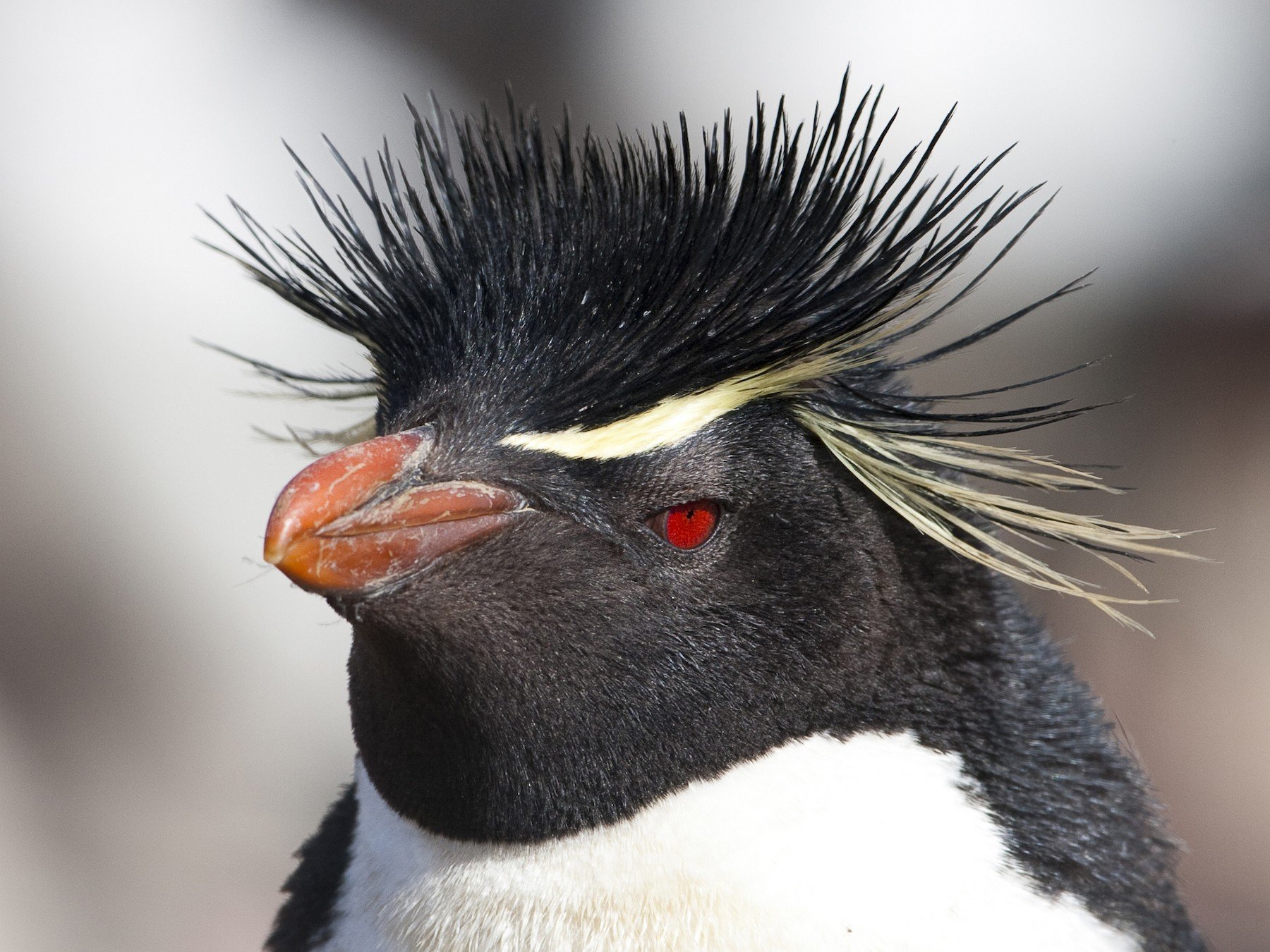
What about penguins then? According to Wikipedia, they’re under /animalia/chordata/aves/etc. I don’t see …/reptilia/dinosauria/ anywhere in that classification. Likewise, seagulls are under /animalia/chordata/aves/… etc. so nowhere near dinosauria. What am I missing here?
What am I missing here?
That untangling evolutionary history is really messy :D It’s not part of Kingdom/Phylum/Class/etc classification, but biologists also use clades to understand evolutionary history. Birds and theropod dinosaurs belong to the clade Theropoda, and to the clade Saurischia which includes some more dinosaurs, and they all belong to the Dinosauria clade which includes all dinosaurs.
The division (as interpreted by evolutionary biologists) between birds and the rest of Saurischia is smaller than the division between Saurischia and the rest of Dinosauria. So, if everything in Dinosauria is a dinosaur, so are birds.
Ok, so what’s the deal with this clade thing? Why don’t we use that for classifying birds?
Then again, maximizing the number of inconsistent exceptions seem to be a running theme in biology, so I guess it’s on brand…
Clades are used for classifying birds and everything else, it’s just a little messier than the neat Kingdom/Phylum/Order/etc way of laying out evolutionary history. If you think of a species as being a specific pinpoint on the tree of life, clades are more like drawing a circle around a lot of pinpoints and branches.
But yeah, biology is nothing but ‘the last thing we taught you was an oversimplification!’ all the way down.
Yeah, that’s biology, all right. 😃
Anyway, thanks for the explanation. Never heard of clade grouping before. Is it handy for dealing with long extinct species, or why does such a grouping even exist?
We do, a clade is just a group consisting of an ancestor and all its descendants. So basically, the evidence indicates that birds are all the descendants of a more traditional dinosaur and are more closely related to more classic dinosaurs like t Rex and velociraptors than those dinos are to ones like brontosaurus.
In part this is done by examining physical characteristics in fossil specimens and seeing where traits seem to appear and how they seem to evolve over time. Like it’s obvious that marsupials are more closely related to us placental mammals than either are to birds or reptiles. After all we give live birth and have hair and milk. And both groups are more closely related to each other than egg laying mammals (monotremes) like platypuses, but that all three are more related to each other than birds, alligators, and lizards. And you can keep going looking at less and less obvious traits. And eventually you see that a weird division in how jaws work happened in the Paleolithic that separated these two clades, and that actually dimetrodon is more closely related to us than to dinosaurs.
And since you can do stuff like that you can see that in the jurassic a group of theropod dinosaurs started evolving feathers, and some even evolved beaks and wings. And by the cretaceous some of these dinosaurs were what we’d call birds today. And even better for them, many were small generalists, which we suspect is the best thing to have been at the end of the cretaceous as species fitting that description seemed to survive the best during the extinction event.
I’d put the stapler in the “seem like/are not” section. Raaaarrrrr
Seems like dinosaur, isn’t: https://i.ebayimg.com/images/g/TGwAAOSw9mFWHRS~/s-l400.jpg
If penguins are still dinosaurs, then earth is still solely inhabited by single cell organisms and we’re clearly not.
wdym “still” dinosaurs? you can’t evolve out of a clade
I’ve never heard of a clade for single cell organisms, though there are some that only contain single cell organisms