I had a client who thought I was a miracle worker for changing the color of every link on the site in under an hour.
Then he got mad because it took me three days to add one field to a form.
Most people cannot begin to comprehend that just having the field on the form doesn’t magically make it do anything. Like, yeah, I can add a field to the form in five minutes, but if you want it to actually work, it’ll take time.
Dotcom days, my company charged a venue $30k for an “emergency change” to disable a form and all links to it.
The dev already had a system switch for it. $30k, 10-second change.
My ex brother in law is a commercial refrigeration tech. He did a emergency call to a restaurant that was losing temp on thier walk in freezer. Loaded with food that needed to be kept under freezing. Time was of the essence or all the food would be tossed due to health codes.
He came out diagnoses it. Qoutes a few grand to fix it. Approved. Then he fixes it in like 15min. Just tightened a single screw.
The owner was pissed he paid a few grand for 15min and a single screw tweak.
Tech looked at him and said he paid for it to be fixed. The fact that the fix was a single screw and which screw needed tweaking was specialized knowledge. He paid for the knowledge not the time.
I took that lesson to heart working in IT or really any field. Even when hiring people to do stuff for me. Sometimes it’s not just the labor it’s also the knowledge.
Isn’t this like an urban legend with a guy tightening a screw? Pretty sure I heard this exact thing but in a factory of some sort
Edit: https://quoteinvestigator.com/2017/03/06/tap/#1bbd5dce-72dc-448e-ac5e-9b48059cef66
Might be so. He said it in the first person so it could’ve been BS.
In software as long as its not rushed you can quote something, fix it in 10 minutes and deliver it the next day and people will be amazed you finished it in under a day.
Underpromise and overdeliver.
I was a Webmaster 15 years ago. I learned very quickly not to say how long anything takes.
Qoute 3~5 times the wrench time. Then report when you like.
Not just the knowledge and time but the urgency too. It was an emergency.
Foresight FTW.
deleted by creator
a { color: pink; }And then you realize that the previous programmer abused the anchors to build all of the buttons.
And 50% of the styles are marked as !important
Hey it’s not my fault, this project was started in 2018 and they choose to use bootstrap.
Oh god I didn’t expect that to give me the level of PTSD flashback that it did.
Fuck bootstrap with a rusty pitchfork.
It’s not as bad as it used to be. Some things require you to use a few more selectors that you’d normally write, but that’s really only tables.
Most stuff is exposed via CSS variables nowadays.
Good to know.
I have not touched it in several years so I just remember the 2013-2019 onslaught of bootstrap.
Not important? Sounds good to me.
(I hate that notation)
To be fair to the client, I, as a programmer, often struggle to estimate tasks with accuracy, and am very often at a loss at even explaining to co-workers why some things are easy and others impossible.
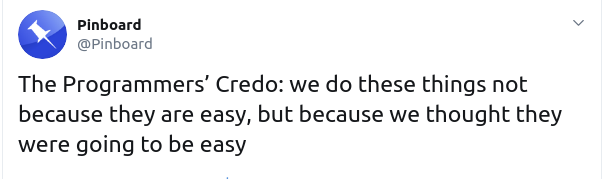
I’ve never felt more called out.
I once just asked how long if would take them to swap the chair and the table, and how long it would take to swap the window and that pillar. After all, it’s just moving stuff around. They understood after that.
Careful, that table is critical for getting airflow over that server in the corner. If you move the table it will overheat and cause a cascade of failures and bankrupt the entire company.
And that’s a load bearing chair.
You’ve just reminded me of a funny time when playing the game Eco with friends. It’s sort of like Minecraft but themed around ecological sustainable technological development, and the specialised labour necessary to make that happen. There were about 8 of us in total, and we would drop in and drop out over the course of a month
The way the electric power system worked in Eco is that in addition to dedicated objects you could place to expand the electrical grid, objects that use electricity could also act as repeaters, albeit with a much smaller radius. They didn’t even need to be physically connected up to power for this to work. They weren’t intended to be used as repeaters; the radius thing was just an artifact of how the electricity mechanic was implemented, to ensure that it wasn’t too complex to build an electric grid.
When we were short of materials and expanding our settlements, I ended up implementing a kludge solution of just placing a few unconnected water pumps between our power station and the place we needed to connect to the grid. It was only intended to be a temporary solution — but there’s nothing more permanent than a temporary solution.
nipped off the server for a little while, and when I came back, everything had gone to hell due to massive outages across the entire grid. After a while of fruitless troubleshooting, I happened to walk past one of the places where there had previously been a water pump, but there was no longer. I discovered that someone had removed it as part of routine tidying up the world.
Surprised and exasperated, I asked my friend why they removed it, and they (justifiably) responded indignantly with “Well I’m sorry! I didn’t know that it was a load bearing water pump!”. “Load bearing water pump” ended up becoming a recurring joke in my friend group, persisting long after we finished playing Eco. The situation really captures the absurd inevitability of this kind of change
This is great. And an excellent lesson as to why you comment your hacks!
I like that metaphor. I’m gonna use it next time I have to talk to a non-technical.
He was okay when I explained that the custom Magento plugin was written in Bulgarian and I had to translate it before attempting to understand the convoluted mess I’d been given.
Should take you an hour of just testing.
I’m sad that the relevant xkcd is kinda obsolete now (because it’s been long enough for that research team to finish doing its thing).
Google photos is alarmingly good at object and individual recognition. It’ll probably be used by the droid war killbots to distinguish “robot” from “human with bucket on head.”
Not a hot dog
I miss that app.
Immich blows Google photos completely out of the water on this, and all locally.
you linked to the page, not the image
My bad. I throught doing that with the page for X CD worked. Could have sworn I’ve done that before

And this is how you summon demons.
What would be a “nearly impossible” task in this post-AI world? Short of the provably impossible tasks like the busy beaver problem (and even then, you would be able to make an algorithm that covers a subset of the problem space), I really can’t think of anything.
Deterministic answers from AI
Most AI are deterministic, it’s only a small subset of AI that are non-deterministic, and in those cases it’s often by design. Also, in many cases, the AI itself is deterministic, but we choose to use the output in a non-deterministic way, e.g. the AI gives a probability output, and will always give the same probabiliies for the same input, and instead of always choosing the one with highest probability, we choose based on the probability weight, leading to a non-deterministic output.
Tl;Dr. Non-determinism in AI is often not an inherit property of the model, but a choice in how we use the model.
Okay, probably fair. I’ve only been working with LLMs that are extremely non-deterministic in their answers. You can ask same question 17 times and the answers have some variance.
You can request an LLM to create an OpenTofu scripts for deploying infrastructure based on same architectural documents 17 times, and you’ll get 17 different answers. Even if some, most or all of them still manage to get the core principals right, and follow the industry best practices in details (ie. usually what we consider obvious such as enforcing TLS 1.2) that were not specified, you still have large differences in the actual code generated.
As long as we can not trust that the output here is deterministic, we can’t truly trust that what we request from the LLM is actually what we want, thus requiring human verification.
If we write IaC for OpenTofu or whatnot, we can somewhat trust that what we specify is what we will receive, but with the ambiguity of AI we can’t currently make sure if the AI is filling out gaps we didn’t know of. With known providers for, say, azurerm module we can always tell the defaults we did not specify.
Wouldn’t you just set the temperature to 0?
Still going to be non-deterministic for any commercial AIs offered to us. It’s a weird technology. I had a link to an article explaining why but I can’t find it anymore.
Ah yeah I was wrong. You set top-k to 1 to get a deterministic output.
Do you have a link explaining what deterministic means in the context of AI? Preferably for noobs
Deterministic means for the same input you always get the same output.
For AI it would be if you ask it a question multiple times using exactly the same words you would get the same answer.
Thank you!
I think more important would be non-chaotic answers. It doesn’t matter too much if their not identical if the content is roughly the same. But if you can get significantly different answers from trivial changes in prompt wording, that really does break things.
Still doesn’t mean it’s correct though.
I think 100% autonomous robotics and driving is still at least 5-10 years away even with large research teams working on it. I mean truly robust AI which is able to handle any situation you could throw at it with zero intervention needed.
Reliability. We can do pretty much anything… with a 5% success rate. Deep learning can take any input, approximate any function and generate the required output, but it’s only as good as the training set and most of them suck. Or it needs to be so large and complex that it’s not fast enough.
Yeah, of course. I think I was misunderstood, which is probably why I got so many downvotes.
Most tasks are possible (and often trivial, given access to the right library) with traditional programming. If it’s possible to do them this way, this is by far the best approach.
Of the things that are not reasonably doable this way, like determining whether a photo is of a bird as in the comic, quite a lot of them are possible nowadays with machine learning (AKA “AI”), and often trivial given access to the right pre-trained model. And in this realm, I would say success rates are very often higher than that. Image recognition is insanely good.
What I’m asking is, what’s a task that’s virtually impossible both with programming and with machine learning?
“Mission critical” tasks which require very high and provable reliability, such as autonomous driving cars, technically fit this question but I think it’s ignoring the point of the question.
And if you were going to mention counterexamples where specially crafted images get mislabeled by AI: this is akin to attacking vulnerabilities in traditional software, which have always existed. If you’re making a low-stakes app or a game, this doesn’t matter.
I think if we’re looking at it conceptually, it has to be something that is too complex to do with traditional heuristics reliably and also doesn’t allow us to generate enough data for good DL results.
There’s also liability to consider, for cases like airplanes and trains. Trains are dead simple to automate, but there needs to be someone there for long tail events, to make people feel safer, and as a fall guy in case of accidents. So in practice it’s impossible to automate beyond subways where you control the entire environment despite the tech being fully capable of it. Same goes for airliners, they practically fly themselves but you need two people there anyway just in case.
Reminds me on how they had a single person (I think?) doing Batman’s cape for the Arkham games. That was their position, the person who makes the cape seem like a real piece of cloth.
I still think about how good the cape looked when flowing or in movement. They did an amazing job either way!
For Assassins Creed Black Flag they had an entire team of like 14 people just making sure the ocean looked pretty.
and then a decade later they did Skull and Bones and somehow it looks way way worse
Different team.
for sure, but it is kinda strange the project that literally spun off Black Flag doesn’t really build upon its established foundation. It felt like part time spare time stop gap pet project at times
That game was the best pirate game that nobody asked for, and it was a freaking Assassin’s Creed game! xD
All they had to do was remove all the bits that made it an Assassin’s Creed game and it would’ve been perfect. But they did Skull & Bones instead. It’s like they hate easy money.
Seriously! I think that’s true about most companies these days. They literally go the worst route possible 90% of the time.
Yakuza Pirate In Hawaii had a similar problem tbh. The pacing of the game kind of encourages you to fuck around doing Yakuza stuff instead of Pirate stuff for the midgame but the Pirate stuff was way more fun than clearing like, 90 bounty fights that all went the same way once you were good at the combat.
Only Assassin’s Creed game I ever played. The worst part was the parts where you’re in the present day and had to do some boring computer shit for some reason? During the whole time in those parts I was just angry and thinking “just let me be a pirate again FFS!”
Yes, oh my god at the times they would bring you out of the Animus for some shitty present day story that wasn’t nearly as interesting as the in Animus story!
Yeah I get they’re trying to do something to connect these stories that take place in completely different time periods and locations. But does anyone really care about that?
There’s some lore about Assassins and Templars in the storyline. I didn’t care about that either (I just want to be a pirate) but maybe some people like that, and it’s enough to connect the various time periods together. But ocassionally warping people into the present day sometimes? It’s just just dumb. I just want to be a pirate!
I played the prior games and it was nice to continue the overall story. It got silly tho and I didn’t play much after black flag.
That ocean looked amazing when the boat didn’t load and there was hole in the ocean with some people and items floating above it.
And it did in fact look really.
In very early 2000s my friends and I used to comment on water appearance in games. If I saw Black Flag ocean then I’d have probably shit myself. Really water was a benchmark between us still recall it on the amd 9500
I love the capes in Helldivers 2 for some reason. That thing gets blown around, there must be some serious draft on the Super Destroyer. Best is when it gets blown over your head and you can’t wiggle it off. You can also wiggle it over your arm and walk around like an ancient roman diplomat.
allegedly, Helldiver’s armor has small fans that keep the cape flowing at all times.
I find cloth physics so fascinating. It’s either really good or garbage. They never got it in destiny or destiny 2, it was always just a mess and they would’ve rather ditched it.
First Dev: “Oof. Uh…hm. Ok. So…no, give me a second, I’m thinking…So, the player character already has an attribute for a familiar that we’re not using, since we removed familiars from the game. We could use that as a scarf, I think. One of the options was a tiger that walked next to the character, we could translate that up and around to the neck. Animation would be tough…could we come up with some reason why the scarf sticks to his shirt? …no? How about a reason why it’s always fluttering behind him? …ok. So yeah, that should work…I think. We’re a month out from code freeze, so we won’t be able to do much with it other than put it in.”
After launch
Project Manager: “Hey, people on Twitch have discovered that some of the player’s clothes disappear randomly if you lose to the lich in level six…?”
Second Dev: “Weird. I’ll take a look…”
Second Dev, in Slack: “Hey, does anyone know why all of the neck-slot customization items are coded as
cats? Turns out the Dog Lich still deletes cat familiars if you lose to it.”Been there, so many times.
Late in Perfect Dark Zero’s development (a complete shitshow to get launched for X360 day 1) we added something called “kill planes”, behind which all entities would get nuked. The aim was that you would physically move through the world and eventually get to “no turning back” points, behind which we could remove all entities to save some cycles.
Turns out there were a large amount of places that assumed that once they had a pointer to an entity that pointer would remain valid.
So yeah, code that was like “I’ll just flip this bit on this entity I kept track of” was now flipping random bits on memory.
These were fun to chase down.
In the end we inplemented NoTaD pointers (“notified on target destruction”, essentially weak pointers but this was back in the day when weak pointers and smart pointers weren’t really well defined) that would discover when the thing they took a precious pointer to was actually no longer valid.
I want to hear so many more of these stories.
In the end we inplemented NoTaD pointers (“notified on target destruction”, essentially weak pointers but this was back in the day when weak pointers and smart pointers weren’t really well defined) that would discover when the thing they took a precious pointer to was actually no longer valid.
It’s weird to me that programming practice has changed that much in 20 years. That’s still closer to today than to Dennis Richie doing his thing.
Also a cautionary tale on adding and removing features without plan or controls. Every ‘hey could we add…? It’s what everyones talking about!’ is another step taken away from the design.
Oh man, this has really cracked me up. You made me laugh so hard I was at risk of waking up my housemates
removed familiars
:(
I appreciate the joke, but the rules are exactly why they go “oof”. The scarf has higher requirements for precision and a more constant overhead than a one-off giant summon.
You could make them go “oof” on the summon if you added a requirement that the lava properly flow along the ground and interact with all characters near the event.
The scarf has higher requirements for precision and a more constant overhead than a one-off giant summon.
I mean, there’s a scarf.

And then there’s a scarf

You could make them go “oof” on the summon if you added a requirement that the lava properly flow along the ground and interact with all characters near the event.
I think the better question is “How many polygons do you want and what do you want them to do?”
Real time simulation of fabrics is a ongoing field of study. It has years of research behind it.
Generally simulated fabrics look good as long as it is flapping in the wind like a flag and has no chance of interacting with any other objects, such as the person wearing a scarf.
“You can choose to play as a mighty warrior, or a free-floating sentient scarf. One or the other.”
The last two-minute-papers video on the subject makes it look like a solved problem, until you notice the stats in the corner are measuring “minutes per frame”
The physics of knitting is so complicated that SciShow fucked it up and had a bunch of people mad at them.
Textiles are complicated crazy wonderful things. The drape of a fabric is going to be related to the materials it’s made of (cotton, linen, wool, acrylics and polyesters, blends of all of the above and more to various percentages…) as well as just the process of making.
Woven is very sturdy and doesn’t stretch. You can’t unwind the whole thing by getting it caught on something. Your jeans and slacks are probably made of woven material, because otherwise you’d accidentally lose your pants to the bump of a nail in a chair or something.
Knit stretches, but accidentally bump into a door hinge and you’ve unraveled a good chunk of your sweater. It’s good at moving though. Most things are done on knitting machines in “stockinette” stitches - look for little ‘v’ shapes.
Gotta keep in mind that the upkeep of clothing was something people use to be spend several hours a week on - beyond just laundry. Weaving takes forever and it’s not particularly exciting. Just imagine how many outfits you’d have in 1600 BC or 1600 AD versus now.
It’s just really crazy that we are all surrounded by billions of tiny fibers that were twisted into single strands that then become fabrics that then become clothes. Each stage presents uniquely complex and beautiful physics problems.
Your last paragraph reminds me of the following series of YouTube videos that goes over how to build a “correct” fluid simulation, starting at the quantum mechanical level (iirc): https://www.youtube.com/playlist?list=PLMoTR49uj6ld32zLVWmcGXaW7w2ey7Vh4.
Multiple scales of complexity and interaction, that’s way too computationally intensive to just directly stimulate how reality works, and so each scale has to be carefully “averaged out”, in a sense, to end up with a simulation that is cheap enough to run yet still behaves realistically and reproduces as many nuances as possible.
Exactly, the first request is so vague that you can just implement it in a way that doesn’t require any complicated programming magic, but a scarf has the implicit expectation to swing around and not intersect with the player or itself. Or worse, expect the player to summon a demon wearing a scarf!
(Still a good joke though)
Or you could go the JRPG way and make the scarf clip through everything including on cut scenes where the devs had 100% of control over the position of everything.
Scarf on the demon is probably fine :) They can bake it into the new movement frames. Player has all kinds of focus and real time physics :)
Let me translate. Adding a completely new object with new rules is easy compared to modifying exist assets and it’s new a clothing peice. Cosmetics are hard to implement, especially a fucking scarf which is on top of all the major animation areas. Do the animations still look good? Do I need to adjust the cutscenes to account for which scarf is being warn? How does this affect lighting?
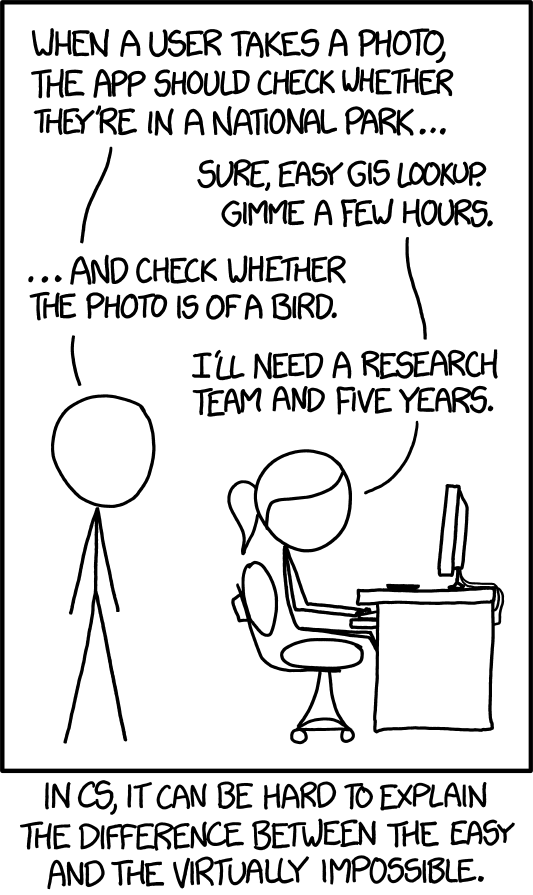
This one is of course outdated now that AI can do the thing
deleted by creator
/c/beatmetoit
I still remember how much of a game changer it was when they had that glass of milk poured in Shrek.
I have also since accepted that “flowy” textures are really hard and that’s the reason every character in every video game ever sleeps without a blanket or a duvet. It always annoy me, even though I understand that having a separate object move with the character is fucked. I get it. Completely. But my brain still goes: how are any of these characters healthy enough to go running around town when they should have severe pneumonia by now???
The difference is: the demon wants to be summoned.
Consent should matter, you know!
Everyone wants a demon bursting through the ground in an explosion of lava. There are classes for that. Nobody has ever asked for a scarf in our game, and our code doesn’t even know what a neck is.
More people want scarves than they considered. Doesn’t mean no one wants it, means they didn’t consider their audience.
I was answering this as a dev and designer. That’s why this is more work.
Don’t forget the magnificent scarf in Shinobi (PS2)
Okay then, how about doors? https://lizengland.com/blog/the-door-problem/
My head canon is that this comic made people work harder on image recognition.
Ended up closer to several departments and 10.
No shit. One is moving an existing model upwards. The other is changing an existing model, adding new cloth physics animation to it, and fixing any animation that involves the scarf. One is a one-time thing, the other is the entire game.
That said, I’m still annoyed RDR2 never made an open collar option for neckerchiefs. Arthur is not Monk, or a Brooklyn hipster.
Now try a classy giant demon with a scarf
As part of the “climbing out of the ground” cutscene, the demon roars with firey breath… Which burns off the scarf.
“Yikes”